It is at the small wavelength end of the electromagnetic spectrum.
A gamma ray has no mass and no charge.
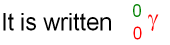
Emitting a gamma ray makes no difference to the mass number
or the atomic number but will make the nucleus more stable.
gcsescience.com 9 gcsescience.com
Gamma rays.
What is a Gamma Ray?
A gamma ray (also written as γ-ray) is an electromagnetic wave.
It is at the small wavelength end of the electromagnetic
spectrum.
A gamma ray has no mass
and no charge.
Emitting a gamma ray makes
no
difference to the mass number
or the atomic
number but will make the nucleus more
stable.
What are the Properties of a Gamma
Ray?
1. A gamma ray has no charge (see above).
2. A gamma ray has
no mass. Of the
three
types of radioactivity
a gamma ray is the least likely to
collide with other atoms
which
means that
(i) gamma
rays have
the most penetrating ability
and are not easily
absorbed. Many centimetres of lead
or a few metres of concrete
will absorb most
gamma rays but some will still get through.
(ii) gamma rays are the least ionising radiation.
Where do Gamma Rays
come from?
Gamma rays are
likely to be emitted
at the same time as
alpha
particles or beta
particles but
some isotopes
only
emit gamma rays (see
some examples).
How can the Direction of a Gamma
Ray be Changed?
Unlike an alpha particle or a beta
particle,
a gamma ray is not
deflected
by a magnetic or electric
field because it has no charge.
 Links
Radioactivity
Revision Questions
Links
Radioactivity
Revision Questions
gcsescience.com Physics Quiz Index Radioactivity Quiz gcsescience.com
Home GCSE Chemistry GCSE Physics
Copyright © 2015 gcsescience.com. All Rights Reserved.