gcsescience.com 25 gcsescience.com
Thickness Control.
How can Radioactivity be used to Control the Thickness of a Material?
The amount of radiation which passes
through a material can
be detected and used to
control the thickness of the material.
The manufacture of aluminium
foil (for cooking) is a
good example.
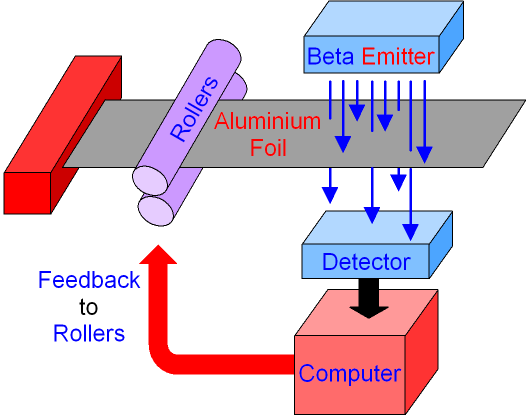
A radioactive source is placed above the foil
and a detector below
it.
Some of the radiation is absorbed by the foil and some radiation
passes through to the
detector. The thicker the foil, the less radiation
passes through to the
detector. The amount
of radiation arriving
at the detector is monitored by the computer. The computer sends
a signal (called feedback)
to control the gap
between the rollers.
The gap between the rollers controls the thickness of the foil.
How does the Feedback Control the Thickness
of the Material?
If the foil is too thick,
less radiation arrives at the detector.
The computer sees that the
level of radiation is too
low
and sends a signal to the rollers to make the gap
smaller.
The smaller gap makes the aluminium foil thinner until the
amount of radiation at the detector increases to
its normal level.
If the foil is too thin,
more radiation arrives at the detector.
The computer sees that the
level of radiation is too
high
and sends a signal to the rollers to make the gap bigger.
The bigger gap makes the aluminium
foil thicker until the
amount of radiation at the detector falls back
to its normal level.
The thickness of paper can be controlled in the same way.
What Radioactive Source is used for Thickness
Control?
The radioactive source
is a beta emitter.
This has the right amount of penetration to be
useful
for thickness control of aluminium foil.
A beta emitter with a half-life of many years would be used so that
1. The count rate would stay almost constant each day.
2. The radioactive source would not have to be replaced very often.
If an alpha emitter was used, all of the alpha particles would be
stopped by the foil and none would
reach the detector.
The computer would not be able to control the foil's
thickness.
If a gamma emitter was used,
all of the gamma
rays would
pass through the
foil and reach the detector. The computer
would not be able to tell
if the foil was too thick or too
thin.
 Links
Radioactivity
Revision Questions
Links
Radioactivity
Revision Questions
gcsescience.com Physics Quiz Index Radioactivity Quiz gcsescience.com
Home GCSE Chemistry GCSE Physics
Copyright © 2015 gcsescience.com. All Rights Reserved.