gcsescience.com 11 gcsescience.com
Elements, Compounds and Mixtures
Changing from a Solid to a Liquid to a Gas by Heating.
Any substance may exist as a solid, liquid or gas.
Heating and Cooling a Solid.
If a solid is
heated enough, it
will melt to become a liquid.
The temperature at which
it melts is called its melting point.
If the liquid is then cooled, it will freeze to become a solid again.
The temperature at which it
freezes is called its freezing point.
The melting point and the freezing point
is the same for the same
substance.
Sometimes a heated solid will
turn into a gas
without first becoming a
liquid. This is called sublimation.
Examples of solids that sublime are iodine and carbon dioxide.
Heating and Cooling a Liquid.
If a liquid is
heated enough, it
will boil to become a gas.
The temperature at which it
boils is called its boiling point.
If the gas is then cooled, it will condense to become
a liquid again.
A gas will condense at its boiling
point.
A liquid can also become a gas by evaporation.
This happens at a temperature below its boiling
point.
Interconverting between a Solid, Liquid and Gas.
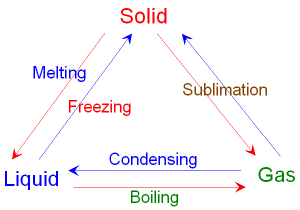
The figure below shows
interconverting
from
one state
to another by heating or cooling.
Red arrows involve heating, blue arrows
involve cooling.
The state of a substance
(whether it is solid, liquid or gas)
depends on its temperature, the
RFM of the
particles
and the forces of attraction
between the particles.
 Links
Solid
Liquid
Gas
Revision Questions
Links
Solid
Liquid
Gas
Revision Questions

gcsescience.com The Periodic Table Index Chemistry Quiz gcsescience.com
Home GCSE Chemistry GCSE Physics
Copyright © 2015 gcsescience.com. All Rights Reserved.