gcsescience.com 5 gcsescience.com
Heat. What is Conduction?
Heat
can be transferred by conduction only in solids.
If one end of a solid is heated, the particles
of the solid
gain kinetic energy. This means that they move faster.
In a solid the
particles
are held together by strong
forces of
attraction. The only way in which the
particles can move is to vibrate forwards and backwards.
When the solid is heated, the
amount by which the particles
vibrate is increased. This is what is meant by saying
that
the particles of the solid have gained
kinetic energy.
The
increase in energy (heat) is
passed on
to the next particle, which in turn starts to
vibrate more.
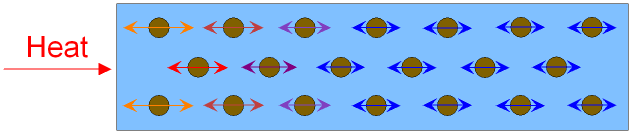
In the above picture, the blue
rectangle represents a
solid
and the amount of vibration is shown by the
length of the arrows. The orange arrows on the left
represent hot
particles. The blue arrows
from the middle onwards represent cold particles.
In non-metals the process of heat transfer by conduction
is slow. It
takes a long time for the particles to
pass
on their heat. Non-metals are
not good
conductors.
They are good insulators (continued
on the next page).
 Links
Energy
Transfer
Revision Questions
Links
Energy
Transfer
Revision Questions

gcsescience.com Physics Quiz Index Heat Quiz gcsescience.com
Home GCSE Chemistry GCSE Physics
Copyright © 2015 gcsescience.com. All Rights Reserved.