gcsescience.com 29 gcsescience.com
What is the Ray Diagram for a Concave Lens?
A concave
lens is a diverging lens
which
makes the rays of light
disperse and spread further apart.
It does the opposite
of a convex lens.
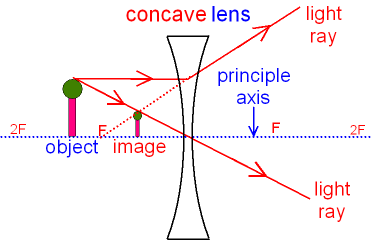
The bottom of the object
is placed on the principle axis.
Two rays of light are
drawn from the top of the object.
The first ray of light
is parallel to
the principle axis
and bends away from it on the right hand
side of the lens.
To find the correct angle
for this ray of light you
trace it back through the focal point
F on the left side.
This part of the ray
is virtual and is drawn
with a
dotted line because the light never really
goes there.
The second ray of light
goes from the top of the object
and passes through the centre
of the lens.
The
second
ray of light
does not change direction (see ray
diagrams).
You draw the top of the image
where the two rays of light
cross.
The bottom of the image
is still on the principle axis.
You can see that the image
is not the same as the
object.
The image is called virtual because the light rays
never really
cross there (compare this with a real
image).
The image is called upright
because it is the right way up
(compare this with an inverted
image). The image is smaller
than the object
and on the same side of the lens
as the object.
 Links
Waves
Light
Revision Questions
Links
Waves
Light
Revision Questions
gcsescience.com Physics Quiz Index Lens Quiz gcsescience.com
Home GCSE Chemistry GCSE Physics
Copyright © 2015 gcsescience.com. All Rights Reserved.