gcsescience.com 16 gcsescience.com
Catalysts - Enzymes - Temperature and pH.
What is an Enzyme?
Enzymes
are catalysts that are produced by living cells.
An enzyme is a protein molecule.
Enzymes are
very specific
catalysts. This means that
one particular
enzyme will act as a
catalyst for one
particular reaction but nothing else.
What are the Optimum Conditions for an Enzyme?
An enzyme will work best at a particular temperature and pH,
called its optimum conditions.
Enzymes usually work
best in warm
conditions (around 35
to 40 °C) unlike chemical
catalysts
which often work best when they are very hot.
What is Enzyme Activity?
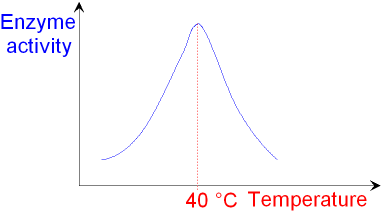
Enzyme activity is a
measure of how well (how efficiently)
an enzyme works as a catalyst. A graph of
enzyme activity plotted against temperature
is shown below.
The enzyme
in the graph above works most efficiently as
a catalyst at 40 °C
. This is the optimum temperature
for this enzyme. Above 40
°C the enzyme begins to work
less efficiently as a catalyst because the
shape of the
enzyme molecule starts to change and it is said to denature.
A
graph of enzyme activity
against pH would have
a similar shape
but the peak (the optimum conditions)
would be at a different pH for different
enzymes.
Pepsin in the stomach
works best at pH = 2.
Amylase in the mouth works best at pH = 7.
 Links
Catalysts and Energy
Enzymes
Revision Questions
Links
Catalysts and Energy
Enzymes
Revision Questions

gcsescience.com The Periodic Table Index Enzyme Quiz gcsescience.com
Home GCSE Chemistry GCSE Physics
Copyright © 2015 gcsescience.com. All Rights Reserved.