gcsescience.com 6 gcsescience.com
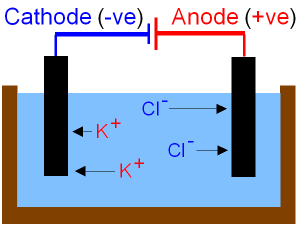
Electrolysis of Potassium Chloride.
Potassium chloride
must be heated until it is molten
before it
will conduct electricity. Electrolysis
separates the
molten ionic compound into its
elements.
The reactions at each electrode are called half
equations.
The half equations are written so that
the same number of electrons
occur in each equation.
2K+ + 2e-  2K (potassium
metal at the (-)cathode).
2K (potassium
metal at the (-)cathode).
2Cl- -
2e-
Cl2
(chlorine gas at the (+)anode).
Potassium ions
gain
electrons (reduction) to form
potassium atoms.
Chloride ions lose
electrons (oxidation) to form
chlorine atoms.
The chlorine atoms combine to form molecules of
chlorine gas.
The overall reaction is
2K+Cl-(l)
2K(s) + Cl2(g)
See some other examples of electrolysis.
 Links
Electrolysis
Revision Questions
Links
Electrolysis
Revision Questions

gcsescience.com The Periodic Table Index Metal Quiz gcsescience.com
Home GCSE Chemistry GCSE Physics
Copyright © 2015 gcsescience.com. All Rights Reserved.