gcsescience.com 15 gcsescience.com
What are the Voltages
across Different Components in a Series
Circuit?
If we measure
the voltage across the
components in the series
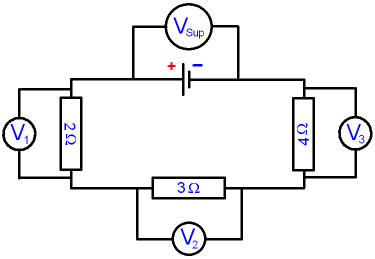
circuit below we find that
1. The voltage for each component depends on its resistance.
The circuit below has three different
resistors
and so V1, V2
and V3 will all be different.
2. The voltage across all of the components
adds up to the supply
voltage from the cell (or battery).
Vsup = V1 + V2 + V3.
In energy terms, the work
done by the cell
on
each coulomb
of charge is equal to the
work done
on all of the components in the circuit.
The supply voltage is shared
between the components.
If there is a change in the resistance
of one component
then the voltage across all
of the components will change.
See how to calculate the voltages in the circuit above.
 Links
Electricity
Series Circuits
Revision Questions
Links
Electricity
Series Circuits
Revision Questions
gcsescience.com Physics Quiz Index Electricity Quiz gcsescience.com
Home GCSE Chemistry GCSE Physics
Copyright © 2015 gcsescience.com. All Rights Reserved.