gcsescience.com 24 gcsescience.com
Artificial
Satellites -
Monitoring,
Information Gathering and the Polar Orbit.
Satellites which gather information
use a polar orbit.
Unlike a geostationary orbit which is above the equator,
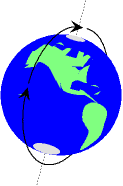
a polar orbit goes over the
North and South Poles.
The polar
orbit shown in the picture above is closer to the
Earth's surface than the geostationary orbit.
The satellite in the polar orbit travels much faster.
One complete orbit may take as little as 3 or
4 hrs.
By the time that the satellite has made one orbit
the Earth will have turned beneath it.
The satellite
sees a new section of the Earth with each orbit.
This type of satellite is ideal
for collecting information
for weather prediction or surveillance (spying)
because
1. It sees the whole surface
each day.
2. It is close enough to the
Earth
to get detailed and reliable
information.
 Links
The Solar System
Revision Questions
Links
The Solar System
Revision Questions

gcsescience.com Physics Quiz Index Solar System Quiz gcsescience.com
Home GCSE Chemistry GCSE Physics
Copyright © 2015 gcsescience.com. All Rights Reserved.