gcsescience.com 32 gcsescience.com
What is a Hydrogen Chloride Molecule?
Chlorine and hydrogen are both non-metals.
A chlorine atom has 7
electrons in its
outer
shell.
Chlorine is in group 7 of the periodic table.
A hydrogen atom has 1 electron in its
outer shell.
Hydrogen can only form 1 bond.
The hydrogen
atom will share its
1 electron
with chlorine
to form one covalent bond
and make a
hydrogen chloride molecule
(HCl).
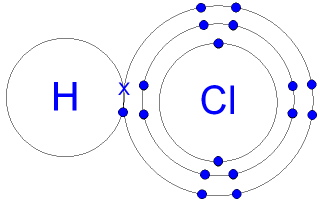
This is a picture of a hydrogen chloride molecule.
By sharing the two electrons where the shells touch
the hydrogen atom can count 2 electrons in its outer shell
and the chlorine atom can count 8 electrons in its outer
shell.
These full outer
shells with their shared electrons are
now stable,
and the
HCl molecule will not
react further
with other chlorine or hydrogen
atoms.
The pair of shared
electrons between the
chlorine and hydrogen atoms form a single
covalent bond.
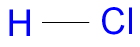
The structural formula of a hydrogen chloride molecule is written
There are no ions present (no + or - charges)
in hydrogen chloride gas
because
the electrons are shared,
not
transferred from one atom to
another.
Hydrogen chloride does form hydrogen
ions and chloride
ions
when it is dissolved
in water to become hydrochloric
acid.
 Links
Revision Quizzes
Revision Questions
Links
Revision Quizzes
Revision Questions

gcsescience.com The Periodic Table Index Covalent Bonding Quiz gcsescience.com
Home GCSE Chemistry GCSE Physics
Copyright © 2015 gcsescience.com. All Rights Reserved.